


2,000 gigawatts of solar power needed for 100% renewables
Industry Trends News, 2020.1.10
Stanford researchers have developed a plan that would balance 2,000 GW of solar capacity and 2,300 GW of wind power with 3,300 GW of battery capacity and a large amount of flexible load. Consumers would save 64% on total energy bills, partly through the electrification of transport and heating.
According to a plan developed by Stanford engineering professor Mark Jacobson and seven co-authors, the US would need 1,500 GW of utility-scale solar power and 500 GW of rooftop solar to reach 100% renewable energy by 2050. Battery capacity of 3,300 GW would balance solar and wind power, supported by 512 GW of average annual flexible load.
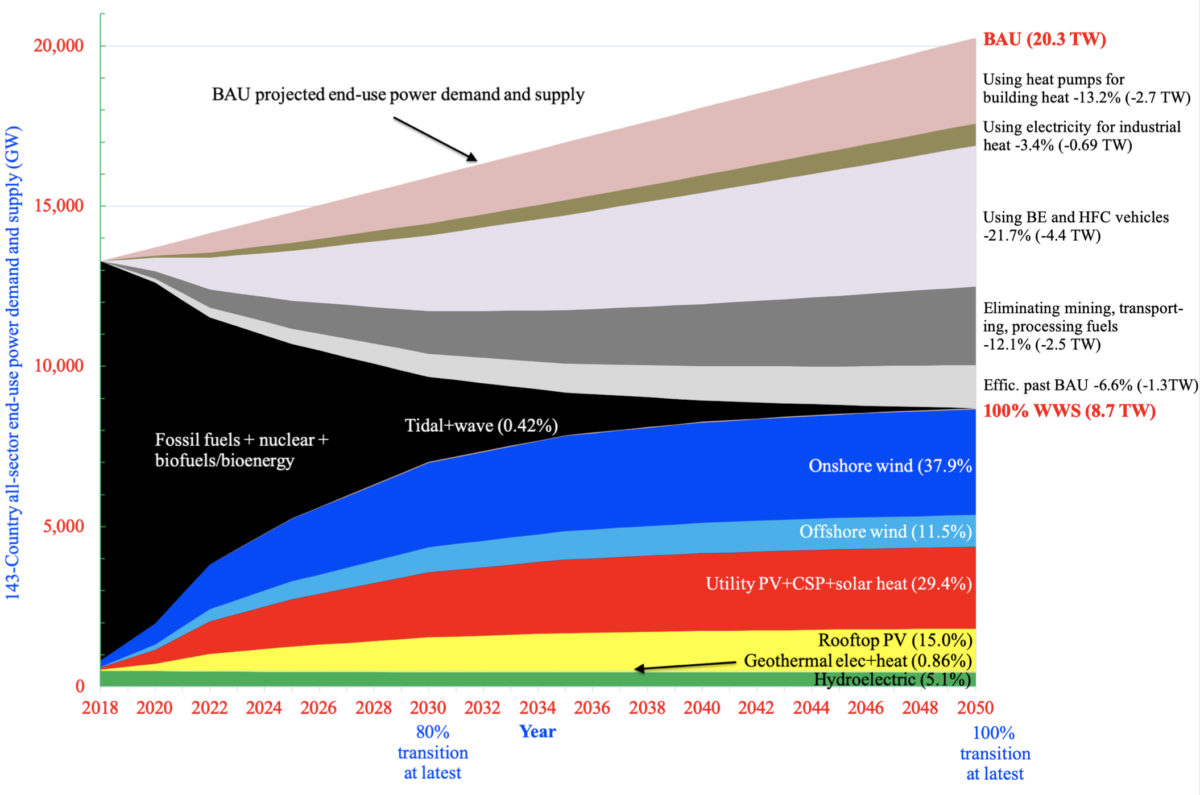
Several states have adopted policy targets aimed at achieving 100% renewable electricity by 2050. However, the Stanford plan goes further by proposing the electrification of all transport and heating. Flexible load to help balance variable renewable energy would include cold storage, heat storage, demand response and hydrogen production for use in fuel-cell-powered trucks.
The authors say that 80% of fossil fuel emissions must be stopped by 2030 to avoid 1.5°C of global warming, citing an earlier study. Reaching 80% of the plan's ultimate US solar target by 2030, starting from the current level of about 75 GWdc, would require a compound annual growth rate of 36% in solar installations, based on a DC-AC ratio of 1.33. This 36% growth rate is notably more ambitious than the 18% annual growth targeted by the Solar Energy Industries Association.
Reaching 80% of the Stanford plan's ultimate 3,300 GW battery capacity target by 2030, starting from the current US level of 1 GW, would require a compound annual growth rate of just over 100%. This compares with an Energy Storage Association post quoting Tom Leyden, Senior Director of EDF Renewables North America, saying: "Over the next 3 to 5 years, you're going to see tremendous growth" in storage. Some consultants estimate that storage could grow 14-fold over the next four or five years. A three-year timeframe would represent an annual growth rate of 100% in installations.
Under the plan, consumers would save 64% on their annual energy costs in 2050 compared with a business-as-usual scenario. This would be due to low-cost solar and wind power, as well as savings from energy-efficient heat pumps, electric vehicles and fuel-cell vehicles. When avoided deaths and illnesses from air pollution and climate benefits are also considered, costs would be 87% lower than in the business-as-usual case.
The plan identifies several industrial processes that could operate mainly during periods of high renewable generation, thereby providing flexible load: "air liquefaction; induction and ladle metallurgy; water pumping with variable-speed drives; and the production by electrolysis of aluminium, chlor-alkali, potassium hydroxide, magnesium, sodium chlorate and copper". Other research has also identified ways to operate desalination as a flexible load.
According to the authors, the global roadmap, which includes plans for every region of the world, would require "only 0.17% and 0.48% of land for footprint and space, respectively".
To conduct their analysis, the Stanford researchers used the LOADMATCH model, which "matches variable energy supply with variable demand, storage and demand response every 30 seconds in each region from 2050 to 2052", as illustrated in the complex set of graphs explained in the paper:
The modelling made the simplifying assumption of "perfect transmission", meaning there would be no transmission congestion. The paper cited previous research showing that, if long-distance transmission congestion becomes an issue, increasing transmission capacity would relieve congestion with only a modest increase in cost.
The Stanford team's paper, "Impacts of Green New Deal Energy Plans on Grid Stability, Costs, Jobs, Health, and Climate in 143 Countries", was published in the journal One Earth and is also available as a PDF.
Quotes from PV-Magazine news on 6 January 2020.
